By Victor Gersten, EA, CFP®, MS, MPAS™
There is a version of this decision that costs nothing and a version that costs a great deal, and the difference between them is often just when and how the money moves.
401k withdrawals in Spain are taxed by Spain, at progressive rates, as if they were salary. That surprises people who assumed a U.S. retirement account carries its U.S. treatment across the Atlantic. It does not, and the mechanics are worth understanding before you take a distribution rather than after.
This article covers how Spain taxes distributions from traditional retirement accounts, which moves are taxable and which are not, what the treaty does and does not do about it, and the sequencing decisions that are still available to you.
What Spain Does With a Distribution
Once you are a Spanish tax resident, Spain taxes your worldwide income. A distribution from a traditional IRA, a 401(k), a 403(b) or a similar U.S. employer plan is rendimiento del trabajo, employment income, and it goes into the general base at the progressive scale.
A binding Spanish ruling in March 2025 addressed this directly and confirmed three things:
- The distribution is fully taxable Spanish income.
- There is no special reduction and no exemption for a U.S. plan.
- The Spanish rules that allow tax-free movement between pension plans apply to Spanish and EU arrangements. U.S. plans fall outside that regime entirely.
The practical consequence is that 401k withdrawals in Spain land in the same bucket as a salary, not in the savings base where dividends and capital gains are taxed at 19% to 30%. The general base combines a state scale with an autonomous community scale that each region sets separately, so what you actually pay depends on where in Spain you live.
The Distinction That Matters Most: Direct Versus Indirect
This is the single most useful thing on this page, and it is a distinction most Americans have never had to think about, because in the United States both routes end up in the same place.
The 2013 protocol to the U.S. Spain tax treaty added a provision on transfers between pension funds, and the Spanish ruling applied it as follows:
A direct transfer between qualified U.S. retirement plans, including plan to IRA, where you never take receipt of the funds, is not a taxable event in Spain. Trustee to trustee, custodian to custodian, the money never touches your hands.
An indirect rollover is a taxable receipt in Spain. The familiar U.S. 60-day rollover, where the plan cuts you a check and you redeposit it within 60 days, is treated by the United States as a non-event. Spain sees you receiving a distribution. The fact that you put it back does not undo that.
So does a transfer into a Spanish pension plan. And so does a Roth conversion, which is a distribution followed by a contribution, and is Spanish taxable income in the year you do it.
If you have consolidation to do, do it as direct transfers, and ideally do it before Spanish residency begins.
Free guide
A personal financial guide to living & retiring in Spain.
Download our free expat guide and join our email list for updates that actually apply to Americans in Spain.
Enter your email in the form at the bottom of this page. Unsubscribe anytime.
What the Treaty Does About the Double Tax
Under Article 20(1)(a) of the treaty, pensions and similar remuneration for past employment are taxable only in the country of residence, which is Spain.
Then the saving clause takes most of that back. Article 1(3) lets the United States tax its own citizens as if the treaty had never existed, and Article 20(1)(a) is not on the short list of provisions protected from it. So the United States taxes your distribution too, under ordinary U.S. rules.
Relief comes from Article 24, which does survive the saving clause. Because the U.S. tax here is imposed by reason of citizenship, Spain’s credit obligation generally does not reach it. Instead the resourcing rule in Article 24(3) treats the income as arising in Spain so that Spanish tax can be credited on your U.S. return, in a separate Form 1116 category for income re-sourced by treaty.
Two practical implications:
- Spanish rates usually govern the total. If Spanish tax on the distribution exceeds the U.S. tax, the credit typically eliminates the U.S. tax and leaves carryforward. Your effective cost is the Spanish number.
- Timing is awkward. Your Spanish return for a year is filed the following spring, after the U.S. return for that year was due. Claiming the Spanish credit usually means electing the accrual method for foreign taxes, or amending.
Required Minimum Distributions Do Not Care Where You Live
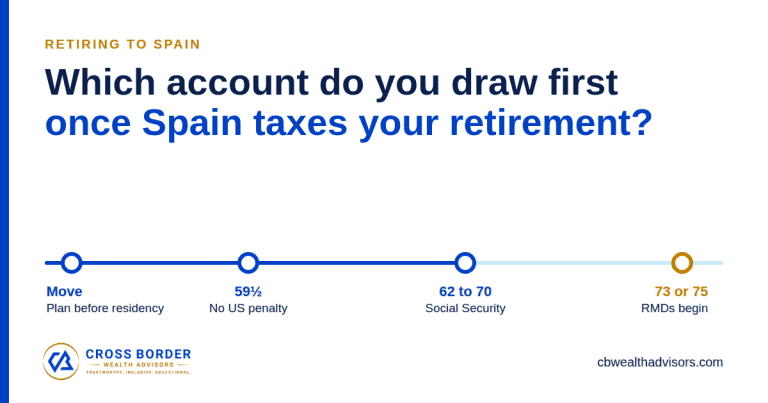
U.S. required minimum distribution rules keep running. The applicable age is 73 for people born from 1951 through 1959, and 75 for people born in 1960 or later. Your first RMD may be deferred to April 1 of the following year, with every subsequent one due by December 31.
Two things worth noting for someone living in Spain:
Deferring the first RMD stacks two into one calendar year. In the United States that is a bracket problem. In Spain it is a bigger one, because both land in the general base at progressive rates. The deferral that looks harmless at home can be expensive here.
Roth IRAs have no lifetime RMD on the U.S. side, but that does not make them free in Spain. Spain does not recognize the U.S. tax-free treatment of a Roth at all, which is its own subject and is covered in The Roth IRA in Spain: What Americans Get Wrong Before They Move.
The 10% Penalty and Other U.S. Rules Still Apply
Nothing about living abroad suspends U.S. rules. If you are under 59 and a half and no exception applies, the early distribution penalty applies on top of the U.S. income tax. The penalty is not an income tax, so it is not something the Spanish side relieves.
Withholding is also worth planning for. A U.S. plan will generally withhold on a distribution, and depending on your total picture that withholding may be far more or far less than your actual liability. That mismatch has to be managed across two filing calendars rather than one.
Sequencing: What Is Still Available to You
Almost every lever here works better before Spanish residency begins. Spain has no split-year treatment, so the calendar year you become resident is fully Spanish, which makes the arrival date itself a planning variable rather than a detail.
Things worth thinking through, none of which is a recommendation without knowing your facts:
- Consolidation. Do it as direct trustee-to-trustee transfers. Never as an indirect rollover.
- Roth conversions. A conversion done while a U.S. resident is a U.S. taxable event only. The same conversion done as a Spanish resident is Spanish taxable income in the general base as well, and Spain will not recognize the resulting Roth as tax-free later. The window closes when residency begins.
- Distribution smoothing. Because the general base is progressive, a large one-time distribution costs more than the same amount spread across years. The instinct to “just cash it out and be done” is expensive here.
- Which account to draw first. The standard U.S. ordering logic assumes U.S. rates on each account type. Spanish characterization moves those assumptions, since employment-base treatment for retirement distributions sits above savings-base treatment for investment income. The full sequencing question is covered in Which Retirement Account to Draw First When You Live in Spain.
- Your custodian. Confirm your U.S. brokerage will keep the account once your address of record is Spanish. Some will not, and a forced liquidation is a distribution you did not choose. See Why US Brokerages Are Closing Expat Accounts, and What to Do About It.
- Do not reinvest proceeds in Spanish funds. Most are passive foreign investment companies under U.S. rules, which turns a solved problem into a new one. See The PFIC Trap.
Two Reporting Points
The account itself is reportable in Spain. A binding Spanish ruling treated U.S. retirement accounts as reportable on Modelo 720 in the securities and insurance block. The reporting obligation exists independently of whether you take a distribution. See Modelo 720: What Americans in Spain Actually Have to Declare.
The account also counts toward Spanish wealth tax. Spain has confirmed that U.S. retirement accounts sit inside the worldwide net wealth base, and that the Spanish exemption for accrued pension plan rights does not extend to U.S. arrangements. There is no treaty relief for the Spanish wealth tax and it is not creditable against U.S. tax.
Frequently Asked Questions
How are 401k withdrawals in Spain actually taxed?
As employment income in the general base at progressive rates, with a state component and a regional component that varies by autonomous community. Not at the lower savings rates that apply to investment income.
Can I roll my 401(k) into an IRA after moving to Spain?
A direct trustee-to-trustee transfer between qualified U.S. plans is not a Spanish taxable event. An indirect 60-day rollover is. The distinction is the whole ballgame.
Should I cash out my 401(k) before I move?
Cashing out is rarely the right answer on either side, since it accelerates U.S. tax and possibly a penalty. What is worth examining before the move is conversions, consolidation and the timing of large distributions, not liquidation.
Does the tax treaty stop Spain taxing my distribution?
No. The treaty allocates the primary right to Spain as your country of residence. The saving clause then lets the United States tax you as a citizen anyway, and relief comes through the resourcing rule on your U.S. return.
Do U.S. required minimum distributions still apply?
Yes. Living in Spain does not suspend them. And deferring your first RMD into the following year stacks two distributions into one Spanish tax year at progressive rates.
Is a Roth conversion a good idea before moving?
It is at least a real question with a closing window, because a conversion after residency begins is taxable in Spain as well, and Spain will not treat the resulting Roth as tax-free afterward. Whether it is right depends on your rates in both systems and your time horizon.
Ready to Talk Through Your Situation?
If you are planning distributions from U.S. retirement accounts and Spain is in the picture, a short call is an easy way to look at the sequencing before you take money out.
Book your free 20-minute intro call
Not sure which situation is yours? See your situation and the package that usually fits.
Important disclosures
This article is general educational information published by Cross Border Wealth Advisors, a company of Gersten Financial Planning Inc. an investment adviser registered with the State of California (CRD 309890). Nothing in it is investment advice, tax advice, legal advice, or immigration advice, and nothing in it is an offer or solicitation to buy or sell any security.
Tax rules in the United States and in Spain change, and their application depends entirely on your own facts. Spanish binding rulings bind the tax administration as to the facts presented to it and are not judicial precedent, and Spanish rulings do not all characterize U.S. retirement account income the same way. Figures, thresholds, rates and filing dates are stated as of the publication date shown above and may have changed since. Before acting on anything described here, and certainly before taking a distribution or making a conversion, consult a qualified professional about your own situation. Where this article says a point is unsettled or unconfirmed, that statement is deliberate and should be treated as a reason to seek advice rather than as a conclusion.
Cross Border Wealth Advisors is a fee-only firm and acts as a fiduciary to its advisory clients. The firm does not sell products and does not receive commissions. Registration with any state securities authority does not imply a certain level of skill or training.
No portion of this article should be read as a promise, guarantee or prediction of any particular tax, investment or planning outcome. Any calculation shown is a hypothetical illustration using round numbers for the purpose of demonstrating a mechanic. It is not a representation of any client’s experience, is not a projection of results, and does not reflect the performance of any actual account.
Web links to third-party sources are provided for the reader’s convenience. Cross Border Wealth Advisors does not control, adopt or endorse the content of linked sites.
Additional information about the firm, including its Form ADV Part 2A brochure and Part 2B brochure supplement, is available at adviserinfo.sec.gov and on request at info@cbwealthadvisors.com.
About the Author
Victor Gersten, EA, CFP®, MS, MPAS™, is a fee-only fiduciary specializing in financial planning for Americans living in or moving to Spain. Victor founded Cross Border Wealth Advisors to serve Americans relocating to Spain, combining an Enrolled Agent’s tax expertise with comprehensive financial planning.
Works Cited
- Dirección General de Tributos, consulta vinculante V0251-25
- Dirección General de Tributos, consulta vinculante V1291-22
- Convention between the United States and Spain, Articles 1, 20 and 24, and the 2013 Protocol
- Agencia Tributaria, Manual Práctico de Renta, general and savings scales
- Agencia Tributaria, Impuesto sobre el Patrimonio, obligations of resident taxpayers
- IRS, Form 1116 instructions, certain income re-sourced by treaty
- IRS, Publication 590-B, distributions from individual retirement arrangements
- U.S. Treasury, final regulations on required minimum distributions (2024)