
By Victor Gersten, EA, CFP®, MS, MPAS™
In almost every conversation I have with someone retiring to Spain, some version of the same question comes up: which account do I take money from first, and when do I start Social Security?
It is a good question, and the usual U.S. answer does not survive the move. The retirement withdrawal strategy most Americans have heard (spend the taxable account first, then the IRA, and leave the Roth for last) was built around U.S. tax rates. Once you are a Spanish tax resident, Spain taxes each of those accounts differently than the United States does, and the order that made sense at home can cost you more here.
This article covers how Spain treats each source of retirement income, why the years between retiring and your first required minimum distribution matter so much, and the sequencing questions worth working through before you take the first dollar out.
Quick answer
There is no single account to draw first in Spain. Traditional IRA and 401(k) withdrawals are taxed in the general base at progressive rates, while sales from a taxable brokerage account are taxed only on the gain, at 19% to 30%, so many retirees blend both each year. The years between retiring and your first required minimum distribution, and anything you can do before Spanish residency starts, often matter most.
Why the U.S. Rule of Thumb Breaks in Spain
The conventional U.S. order assumes three things: that selling investments in a taxable account is taxed lightly, that IRA withdrawals are taxed as ordinary income at U.S. rates, and that Roth money comes out tax-free.
In Spain, only the first assumption roughly holds. Spain splits your income into two buckets:
- The savings base (base del ahorro), where interest, dividends and capital gains are taxed at 19% to 30%.
- The general base (base general), where salaries, pensions and retirement account distributions are taxed at progressive rates that combine a state scale with a regional scale. The top combined rate runs from about 45% in Madrid to about 54% in the Comunidad Valenciana.
So the question in Spain is not only “which account,” but “which bucket does this withdrawal land in, and how full is that bucket already this year.”
How Spain Treats Each Source of Retirement Income
| Income source | How Spain taxes it | What to keep in mind |
|---|---|---|
| Traditional IRA, 401(k), 403(b) | General base, progressive rates, as employment income | The whole distribution is taxable in Spain. The United States taxes it too, and relief comes mainly through the foreign tax credit on your U.S. return. |
| Roth IRA | Spain does not recognize the U.S. tax-free treatment | Withdrawals can create Spanish tax even though the IRS sees nothing to tax. Details in our Roth article, linked below. |
| U.S. Social Security | General base, progressive rates | Both countries tax it under the treaty. How the double tax is relieved is not fully settled. |
| Selling investments in a taxable brokerage account | Savings base, 19% to 30%, on the gain only | The part of each sale that is your original investment is not taxed. Spain measures the gain from what you paid, not from the value on the day you became resident. |
| Interest and dividends | Savings base, 19% to 30% | Taxed as received, whether you spend them or not. |
| Cash savings | Not taxed when spent | Only the interest it earns is taxed. |
The practical takeaway is that a dollar from a traditional IRA and a dollar from your brokerage account are very different dollars in Spain. The IRA dollar is fully taxable in the general base. The brokerage dollar is only partly taxable (the gain portion), and at the lower savings rates.
Free guide
A personal financial guide to living & retiring in Spain.
Download our free expat guide and join our email list for updates that actually apply to Americans in Spain.
Enter your email in the form at the bottom of this page. Unsubscribe anytime.
A Simple Illustration
Here is a hypothetical example with round numbers, only to show the mechanic. Say you need €60,000 to live on this year, you have no pension yet, and you have not started Social Security.
Option A: You take the full €60,000 from a traditional IRA. All €60,000 goes into the general base at progressive rates.
Option B: You take €30,000 from the IRA and sell €30,000 of investments in a brokerage account, where roughly half of what you sell is gain. Now €30,000 goes into the general base and about €15,000 goes into the savings base. The other €15,000 is your own money coming back to you and is not taxed.
Option B puts far less income in the expensive bucket this year. It is not automatically the right answer, because draining the brokerage account now leaves more in the IRA for later, when required minimum distributions and Social Security may push you into higher general base brackets. That tension is the whole planning problem, and it is why the answer depends on your numbers and on where in Spain you live.
The Years That Matter Most
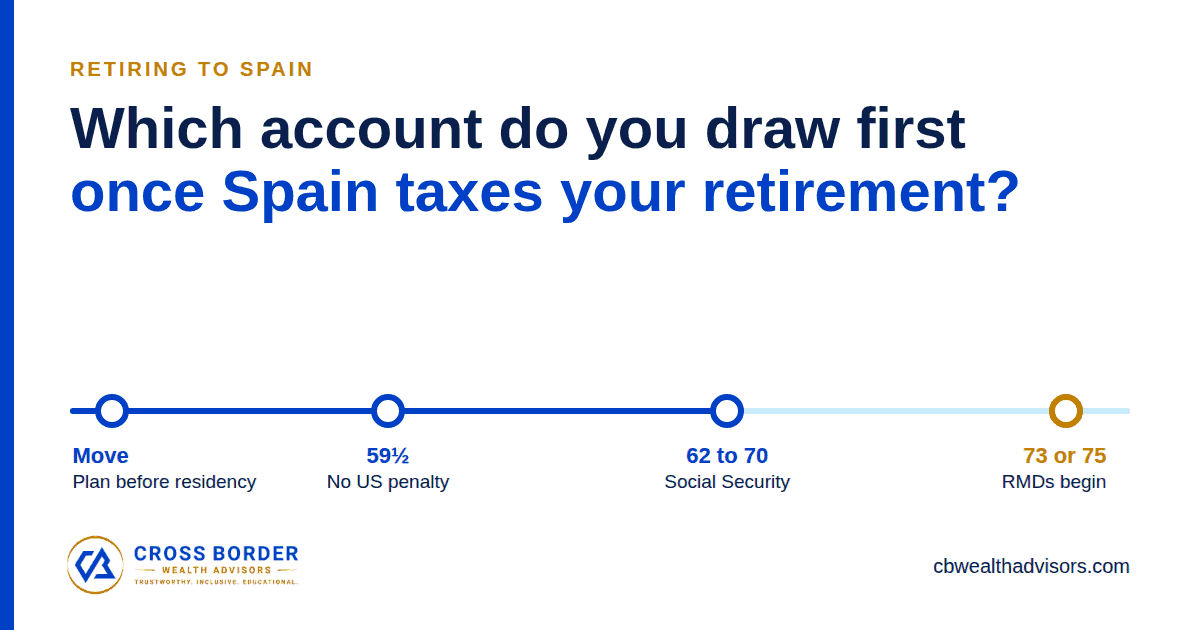
For most people the best planning window is the stretch between the year you stop working and the year your required minimum distributions begin. During those years your general base can be relatively empty, which makes them the cheapest years to draw on pre-tax accounts.
A few dates frame that window:
- Age 59 and a half. Before this age, IRA withdrawals generally carry the U.S. 10% early distribution penalty unless an exception applies. The penalty is not an income tax, so Spain gives no relief for it.
- Age 62 to 70. The Social Security claiming window. Each year you wait increases the benefit, and it also keeps that income out of your Spanish general base until you claim.
- Age 73 or 75. Required minimum distributions start at 73 if you were born from 1951 through 1959, and at 75 if you were born in 1960 or later. Living in Spain does not change this.
The concern I hear most often is some version of “if I wait, the RMDs will be huge and Spain will tax them at the top rate.” It is a fair concern. If you let a large IRA grow untouched until 75, and Social Security is already running, the combined income can land well into the upper general base brackets every year. Drawing some of the IRA earlier, in years when the general base is lower, is often how that pressure is reduced. Keep in mind that deferring your first RMD to April 1 of the following year stacks two distributions into one Spanish tax year, which usually works against you here.
Before You Become a Spanish Resident
Several of the most useful moves only work while you are still a U.S. resident, because Spain has no split-year treatment. The calendar year you become resident is fully Spanish.
- Roth conversions. A conversion done before residency is a U.S. taxable event only. The same conversion after residency begins is also Spanish taxable income in the general base.
- Realizing gains in the brokerage account. Because Spain taxes gains from your original cost, selling and rebuying appreciated positions before you arrive can raise your cost basis for Spanish purposes. Whether it is worth it depends on the U.S. tax on that sale.
- Consolidating accounts. If you are rolling a 401(k) into an IRA, do it as a direct trustee-to-trustee transfer. An indirect 60-day rollover is a taxable receipt in Spain. More on the mechanics in Cashing Out a 401k While Living in Spain.
- Checking your custodian. Make sure your brokerage will keep the account once your address is in Spain, and that you will still be able to buy what you need inside it. See Why US Brokerages Are Closing Expat Accounts, and What to Do About It.
Where the Wealth Tax Fits In
Spain also taxes net wealth above certain thresholds, with rules that vary by region. U.S. retirement accounts count toward that base, and so do brokerage accounts. They are also reportable on Spain’s foreign asset return, covered in Modelo 720: What Americans in Spain Actually Have to Declare. Spending down taxable assets first can slowly reduce the wealth tax base, while money left to grow in an IRA keeps counting every year. For households near or above the thresholds, this becomes one more input into the withdrawal order. The valuation rules and regional differences are worth reviewing before you settle on a withdrawal order.
A Practical Order to Think Through
There is no universal sequence, and none of the following is a recommendation without knowing your facts. That said, these are the questions I work through with clients, in roughly this order:
- What can I do before residency starts? Conversions, gain harvesting, consolidation and custodian changes all get harder or more expensive afterward.
- How much general base room do I have each year until RMDs start? This is usually the key number, and it depends heavily on your region.
- How much should come from the brokerage account versus the IRA each year? Often a blend, adjusted every year, rather than one account first and the other later.
- When should Social Security start? Claiming later keeps the early years lighter and raises the benefit, but it adds more to the general base later, on top of RMDs.
- What happens at 73 or 75? Project the RMD years before you get there, not the year they start.
- Where is the Roth in all of this? Since Spain does not treat it as tax-free, the Roth is not automatically the last account to touch.
The answer usually looks less like a fixed order and more like a yearly plan: a target amount from each source, reviewed each year against both tax returns.
Frequently Asked Questions
Which account should I withdraw from first when I retire in Spain?
There is no single answer. In Spain, traditional IRA and 401(k) withdrawals land in the general base at progressive rates, while sales from a taxable brokerage account are taxed only on the gain, at 19% to 30%. Most retirees end up blending both each year rather than emptying one account first.
Does Spain tax my IRA withdrawals?
Yes. Once you are a Spanish tax resident, distributions from traditional IRAs and U.S. employer plans are taxed in the general base as employment income. The United States taxes them as well, with relief mainly through the foreign tax credit on your U.S. return.
Is it better to delay Social Security if I live in Spain?
Not automatically. Delaying raises the benefit and keeps the early years lighter in the Spanish general base, but it adds more income later, when required minimum distributions may also be running. It depends on your other income, your region and your ages.
Do required minimum distributions still apply if I live in Spain?
Yes. They start at 73 if you were born from 1951 through 1959, and at 75 if you were born in 1960 or later. Spain taxes them in the general base like any other distribution.
Should I leave my Roth IRA for last?
Not necessarily. Spain does not recognize the U.S. tax-free treatment of a Roth, so the usual reason to leave it for last is weaker. Where it fits depends on your whole picture.
Is there anything I should do before moving?
Yes, because Spain has no split-year treatment. Roth conversions, realizing gains to raise your cost basis, and consolidating accounts through direct transfers are generally easier and cheaper before your first year of Spanish residency.
Ready to Talk Through Your Situation?
If you are retiring to Spain and want to see how your accounts, Social Security and RMDs fit together across both tax systems, a short call is an easy way to start.
Book your free 20-minute intro call
Related reading: Cashing Out a 401k While Living in Spain: The Tax Consequences · The Roth IRA in Spain: What Americans Get Wrong Before They Move · Five Financial Mistakes Americans Make Before Moving to Spain
Not sure which situation is yours? See your situation and the package that usually fits.
Important disclosures
This article is general educational information published by Cross Border Wealth Advisors, a company of Gersten Financial Planning Inc. an investment adviser registered with the State of California (CRD 309890). Nothing in it is investment advice, tax advice, legal advice, or immigration advice, and nothing in it is an offer or solicitation to buy or sell any security.
Tax rules in the United States and in Spain change, and their application depends entirely on your own facts. Figures, thresholds, rates and filing dates are stated as of the publication date shown above and may have changed since. Before acting on anything described here, and certainly before taking a distribution, making a conversion or choosing a Social Security claiming age, consult a qualified professional about your own situation. Where this article says a point is unsettled or unconfirmed, that statement is deliberate and should be treated as a reason to seek advice rather than as a conclusion.
Cross Border Wealth Advisors is a fee-only firm and acts as a fiduciary to its advisory clients. The firm does not sell products and does not receive commissions. Registration with any state securities authority does not imply a certain level of skill or training.
No portion of this article should be read as a promise, guarantee or prediction of any particular tax, investment or planning outcome. Any calculation shown is a hypothetical illustration using round numbers for the purpose of demonstrating a mechanic. It is not a representation of any client’s experience, is not a projection of results, and does not reflect the performance of any actual account.
Web links to third-party sources are provided for the reader’s convenience. Cross Border Wealth Advisors does not control, adopt or endorse the content of linked sites.
Additional information about the firm, including its Form ADV Part 2A brochure and Part 2B brochure supplement, is available at adviserinfo.sec.gov and on request at info@cbwealthadvisors.com.
About the Author
Victor Gersten, EA, CFP®, MS, MPAS™, is a fee-only fiduciary specializing in financial planning for Americans living in or moving to Spain. Victor founded Cross Border Wealth Advisors to serve Americans relocating to Spain, combining an Enrolled Agent’s tax expertise with comprehensive financial planning.
Works Cited
- Agencia Tributaria, Manual Práctico de Renta, general and savings scales (2026)
- Ley 35/2006 del IRPF, Articles 17, 33 to 35 and 46
- Dirección General de Tributos, consulta vinculante V0251-25
- Convention between the United States and Spain, Articles 1, 20 and 24, and the 2013 Protocol
- IRS, Publication 590-B, distributions from individual retirement arrangements
- U.S. Treasury, final regulations on required minimum distributions (2024)
- U.S. Social Security Administration, retirement benefits by claiming age