
Victor Gersten, EA, CFP®, MS, MPAS™
Spain is not obliged to honor a tax break that exists only in US law. The US-Spain treaty does not close that gap the way the UK and France treaties do.
This is one of the most common questions I get from Americans planning a move to Spain. It usually arrives with a lot of confidence attached. Someone has spent twenty years paying tax on the way into a Roth, on the promise that nothing would be taxed on the way out.
That promise is real, and it holds. It holds in the United States. It is a feature of the US tax code rather than a property of the account.
Spain runs its own system. A Spanish tax resident is taxed there on worldwide income. What follows is general information, not advice on your own accounts.
Why Americans assume a Roth is tax-free everywhere
You fund a Roth IRA with money you have already paid US tax on. There is no deduction going in. The account grows without current US tax. A qualified distribution comes out free of US federal income tax, as the IRS sets out in Publication 590-B.
That outcome is so clean that people stop thinking of the Roth as an account. It becomes a category: the money that is finished being taxed.
The shortcut works while you live in the United States. It stops working the moment another country gains the right to tax you. No other country is bound by the label the US applies.
In plain terms: the US decided a qualified Roth distribution is not income. Spain never agreed to that, and nothing in Spanish law imports the conclusion.
What the US-Spain treaty actually says
This is where the reassuring version falls apart. People assume a treaty provision carries the Roth’s character across the border, because they have read that such a provision exists somewhere.
The treaty dates from 1990, and the 2013 protocol amended it. Working from the treaty documents published by the IRS, there is no Roth carve-out anywhere in the text.
What the treaty has is generic pension language. Article 20(1)(a) covers pensions and similar remuneration for past employment, taxable only in the state of residence.
Read that carefully. The word Roth does not appear. Neither does IRA. Neither does any account-specific provision of the kind found in the UK and France treaties.
Let me be precise rather than dramatic. The treaty does not say Spain may tax your Roth. It says nothing that preserves the Roth’s US character for Spanish purposes. Spain is not obliged to respect a characterization that exists only in US domestic law.
That absence of protection is the whole problem. It is a different claim from “the treaty taxes you,” and it is the accurate one.
One Spanish source worth knowing about
A binding consultation from Spain’s Dirección General de Tributos, V1133-17 of 10 May 2017, addresses IRA taxation for someone relocating from the US to Spain. It discusses both traditional and Roth accounts.
I have only reviewed a secondary summary rather than the DGT’s own text. So I will describe its direction, not its words. The reported reasoning treats IRA distributions under the treaty’s residual income article. It gives Spain the primary taxing right as state of residence. It preserves the US citizenship-based right through the saving clause, and requires Spain to credit US tax paid.
Keep in mind what a binding consultation is. It binds the administration on the facts presented to it. It is not legislation, and it is not a general rule for every American with an IRA. If your plan depends on it, your Spanish adviser should pull the text and read it against your facts.
Free guide
A personal financial guide to living & retiring in Spain.
Download our free expat guide and join our email list for updates that actually apply to Americans in Spain.
Enter your email in the form at the bottom of this page. Unsubscribe anytime.
How Spain taxes a Roth withdrawal
Let me explain the mechanic. Once you see it, the rest follows.
The United States treats a qualified Roth distribution as not income. So there is no US tax on it. So there is no US tax available to credit against anything.
Spain taxes a resident on worldwide income. It sees a distribution from a foreign retirement arrangement and taxes it under IRPF.
The result is uncomfortable. You can pay Spanish tax on money you were told would never be taxed again, with no foreign tax credit to soften it, precisely because you paid the US tax years earlier.
That asymmetry is the heart of the issue. It is not a loophole and it is not a penalty. It is two systems that never agreed on when the tax was due.
The savings scale, and the flat 30% claim that is wrong
A lot of what circulates describes Spain’s savings tax as “a flat 30%.” That is not correct, and it badly overstates the number for the typical reader.
Ley 7/2024, de 20 de diciembre, changed the savings scale, effective 1 January 2025. The combined state and regional scale runs as follows.
| Savings income band | Rate |
|---|---|
| Up to €6,000 | 19% |
| €6,000 to €50,000 | 21% |
| €50,000 to €200,000 | 23% |
| €200,000 to €300,000 | 27% |
| Above €300,000 | 30% |
For most Roth holders the relevant bracket is 19% or 21%. The 30% band applies only above €300,000 of savings income. That is a different conversation from the one most readers are having.
No further change takes effect for 2026. Articles headlined “new 2026 savings rates” are describing the 2025 rates as they get filed during the 2026 campaign.
A worked example
Here is a hypothetical illustration with round numbers. A €40,000 distribution taxed entirely on the savings scale attracts 19% on the first €6,000 and 21% on the remaining €34,000. That is roughly €8,280, or about 20.7% overall. Your own result depends on your figures, your region, your other income and the question below.
The characterization question is the one that matters
Does Spain treat your Roth distribution as savings income on the 19% to 30% scale, or as general income on the higher general scale? That is not uniformly settled. It can depend on how the account and the distribution are characterized. General-income treatment would be materially worse. Resolve it with Spanish tax counsel before taking a large distribution, not after.
Why the UK and France answers do not apply
Here is where much of the confusion starts. The US treaties with the United Kingdom and with France contain express provisions preserving a Roth’s tax-free character for the resident country.
Spain’s treaty has no equivalent. Same account, same taxpayer, different country, different answer.
So the sentence “my Roth is protected by treaty” is true in some places and simply not established in Spain. Generic expat content written for a London audience is a reliable way for someone moving to Valencia to get this wrong.
I will not attempt an article-by-article reading of those treaties here. The practical point does not need it. If you are relying on a treaty argument, it has to be the treaty that applies to you.
Roth or traditional IRA: which is better in Spain?
This is the counterintuitive part, and it is where the standard US answer can invert.
In the United States, the Roth generally beats the traditional IRA for someone expecting meaningful growth and stable or rising rates. Once Spain may tax the distribution anyway, part of that advantage disappears. The US benefit you paid for in advance does not travel with you.
Meanwhile a traditional IRA distribution is taxable in both countries. That sounds worse. In a single-country analysis it is. In a cross-border analysis it does something useful. It generates an actual US tax liability, and that US tax can generally be credited against the Spanish tax on the same income.
I am not going to say traditional always wins, because it does not. The answer depends on your Spanish bracket, your US bracket, the size and timing of distributions, whether the Beckham regime applies, and whether you intend to return to the United States.
This part of the work does not divide cleanly between a tax preparer and a financial planner. As an EA and a CFP® professional, I run the US return and the Spanish position against the same plan, in the same conversation. The answer only appears when both sides are on the table.
The pre-move conversion window
There is a window before Spanish residency begins. It is worth understanding even if you decide not to use it.
A Roth conversion done in a year when you are not a Spanish tax resident is a US-only event. You pay US tax on the converted amount that year. The conversion does not enter the Spanish tax base.
The 183-day trap
The timing point is easy to get wrong, and getting it wrong is expensive. Spanish residency generally attaches once you spend more than 183 days of the calendar year in Spain. It then applies to the entire year, not from your arrival date forward.
So a conversion in March, followed by a June move that takes you past 183 days, sits inside a year when you were resident throughout. It is not protected by having happened before you got on the plane.
The window that works is a conversion in a year when you will not become Spanish tax resident at all. For most people that means the year before the move. It can also mean a move late enough that the day count is not met. That is why the month you move is a planning variable, not a logistical one.
The conversion itself accelerates US tax deliberately. You choose to pay now, at a rate you can see, rather than later at a rate you cannot.
What a conversion does not solve
A pre-move conversion does not solve the problem this article is about. Spain may still tax the eventual distribution. So converting before you leave can mean full US tax on the way in and Spanish tax on the way out.
I would work through the decision in this order.
- What is your US marginal rate in the conversion year? Is it unusually low, because of a gap year or a year between jobs?
- Do you expect to draw on the account while resident in Spain? Or would you leave it invested and return to the US first?
- Does the Beckham regime apply in your first years? If so, does it change the timing?
- How large is the account relative to your other assets? How much flexibility do you have on when to withdraw?
A pre-move conversion can be sound for reasons that have nothing to do with Spain. It can also be exactly wrong for someone retiring there permanently. I will not give a recommendation in an article. That answer belongs to your numbers.
Do you declare a Roth on Modelo 720?
I will keep this short and honest. The honest answer is that it is unsettled.
Whether Spain requires you to report a US IRA or Roth is fact-specific, and Spanish guidance has not resolved it with a single rule. The analysis turns on whether the plan’s terms give the holder a redemption right similar to a life insurance policy. The binding consultations on foreign pensions work through each product case by case.
In practice many advisers take the conservative view and report. The right step is a Spanish counsel opinion on your own plan documents, not a rule of thumb from a forum.
One related question is much clearer. An ordinary US taxable brokerage account is reportable once it crosses the threshold. That is a separate obligation from anything to do with retirement accounts.
Working with a cross-border adviser
If you take one thing from this article, make it the sequencing. The Roth questions that matter are decided before you move. Several cannot be reopened afterward.
What the process looks like
We inventory the accounts and confirm what is actually a Roth, a traditional IRA, a rollover, or a plan still sitting with a former employer. We model the US cost of converting in a given year against the Spanish cost of distributing later, under both scales, so you see a range rather than a single number.
The calendar matters too, since your arrival date drives your first Spanish residency year. We check whether the Beckham regime is available and whether it changes the withdrawal order. Then we coordinate with Spanish tax counsel on the characterization and Modelo 720 questions. Those are Spanish law questions and a Spanish professional should answer them.
The reason I do this as both an EA and a CFP® professional is simple. A Roth decision needs the US return and the Spanish return built on the same assumptions. The easiest way to ensure that is to decide both in one conversation.
Cross Border Wealth Advisors is a fee-only fiduciary, and none of this depends on which account you end up using. Weighing a conversion, or with a move on the calendar? You can book an introductory conversation at cbwealthadvisors.com or email info@cbwealthadvisors.com.
What to do next
Before you convert anything, put three documents in front of one adviser. Your most recent US return. A list of every retirement account with its type and balance. Your intended arrival date in Spain. Those three answer most of the sequencing questions, and they cost nothing to assemble.
Sources
- IRS, Spain tax treaty documents
- IRS, About Publication 590-B
- BOE, Ley 7/2024, de 20 de diciembre
- Agencia Tributaria, gravamen de la base liquidable del ahorro
Retirement accounts are one of five areas worth reviewing before you set a residency date. The rest are in Five Financial Mistakes Americans Make Before Moving to Spain.
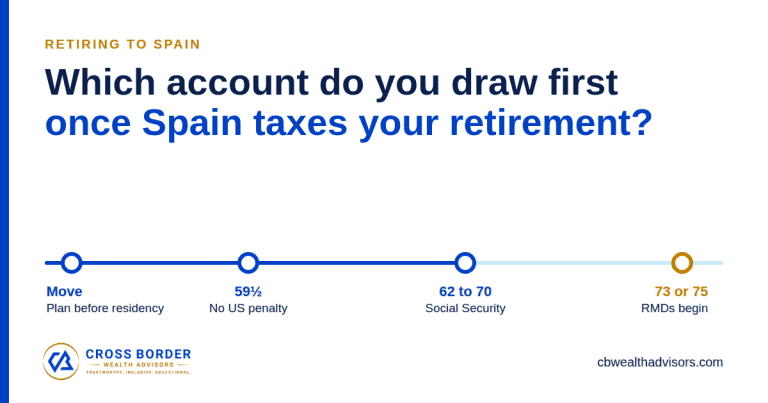
Related reading: Retirement planning across two countries · Investing in Europe as an American Retiree · Which Retirement Account to Draw First When You Live in Spain
Disclosures
This article is general educational information published by Cross Border Wealth Advisors, a company of Gersten Financial Planning Inc., an investment adviser registered with the State of California (CRD 309890). It is not investment, tax, legal or immigration advice.
Rules and figures change. The ones here are stated as of the date above. Any calculation shown is a hypothetical illustration, not a projection and not any client’s experience. Cross Border Wealth Advisors is fee-only and receives no commissions. Registration does not imply a certain level of skill or training.
Please read the full article disclosures, which apply to everything published here.
Not sure which situation is yours? See your situation and the package that usually fits.