
Victor Gersten, EA, CFP®, MS, MPAS™
If your working life has been split between countries, retirement planning stops being a single calculation.
Two tax systems can reach the same pension. And the order in which you do things often matters more than what you own.
This article is for people whose careers crossed borders and who now have to decide where to retire. It uses the United States and Spain as the working example. It is general information, not advice about your situation.
Where will your retirement income be taxed?
Start with the question that drives everything else.
Retirement income is generally taxed where you are tax resident when you receive it. Not where you earned it. Not where the account sits.
That single point reframes most of the planning. A 401(k) funded across twenty years in California is taxed by Spain if you are a Spanish tax resident when the distribution comes out. The fact that the account never left Schwab changes nothing.
The United States adds a second layer that almost no other country has. US citizens and green card holders pay tax on worldwide income wherever they live. So moving abroad does not end the US return.
Two systems therefore reach the same money. The treaty between them decides how the overlap resolves.
What a treaty does, and does not do
The United States has income tax treaties with dozens of countries, including Spain.
A treaty allocates taxing rights between the two states. It also provides mechanisms, mainly the foreign tax credit, to stop the same income being taxed twice in full.
What a treaty generally does not do is preserve a tax benefit that exists only in one country’s domestic law.
The clearest example is the Roth IRA. The US treats a qualified Roth distribution as not income at all. The US-Spain treaty contains nothing that carries that characterization across the border. The UK and France treaties do. The Roth IRA in Spain works through it.
Social security contributions use a separate instrument. The US-Spain totalization agreement keeps you out of both systems at once. It also lets you combine work histories to qualify for a benefit.
That matters a great deal to anyone with a split career. The US-Spain Totalization Agreement covers the mechanics, including the certificate of coverage self-employed people need.
US retirement ages still apply abroad
US retirement account rules follow the account, not your address. So these dates continue to apply after you move.
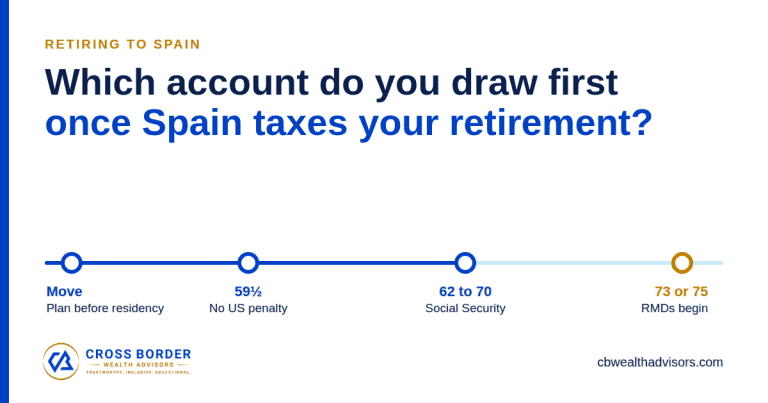
| Milestone | Current rule |
|---|---|
| Penalty free withdrawals | Generally age 59 and a half, for IRAs and employer plans alike |
| Rule of 55 | Separation from service in or after the year you turn 55. Employer plans only, not IRAs |
| Required minimum distributions | Begin at age 73 under current rules |
The RMD age is worth stating carefully. A great deal of published material is out of date.
SECURE 2.0 moved the beginning age to 73. It also provides for a further increase to 75 for later cohorts. Treasury has addressed the precise cutoff in proposed regulations rather than final ones. So anyone born near the boundary should confirm their own applicable age rather than rely on a general article, including this one.
The cross-border point is that an RMD is a forced distribution. If you are a Spanish tax resident when it lands, it enters the Spanish tax base whether or not you needed the money. That is exactly the kind of event to plan around in advance.
Sequencing decides the outcome
For someone with a two-country career, the highest value planning happens in a narrow window before residency changes.
Decisions taken while you are still solely a US tax resident are US-only events. Realizing capital gains. Exercising options. Converting to a Roth. Selling a business interest. All of them look very different in a year when a second country also has a claim.
The timing trap
Spanish tax residency generally attaches when you spend more than 183 days of the calendar year in Spain. Once it attaches, it applies to the whole calendar year rather than from your arrival date onward.
So a transaction completed in March, followed by a June move that takes you past the day count, sits inside a year when you were a Spanish tax resident throughout.
The month you move is a planning variable, not just a logistical one.
Investment restrictions you will meet
Two constraints surprise people who assumed they could keep investing as they always had.
On the US side, nearly every non-US pooled fund counts as a passive foreign investment company. That brings a punitive default regime and a separate Form 8621 for each holding. The locally sold fund your new bank recommends is usually the wrong thing for an American to own. The PFIC Trap explains why.
On the European side, the PRIIPs regulation means US-domiciled ETFs generally cannot be sold to EU-resident retail investors. US issuers do not produce the required Key Information Document. Many brokers block those purchases once your address changes.
There is a custody question underneath both. Some US institutions restrict or close accounts once the address of record becomes foreign. The fix has its own tax cost if positions have to be sold. Why US Brokerages Are Closing Expat Accounts covers what to do.
Reporting on both sides
A two-country retirement brings filing duties that exist whether or not you owe extra tax.
On the US side, the FBAR applies once your foreign financial accounts exceed $10,000 in aggregate at any point in the year. You file it with FinCEN rather than the IRS.
FATCA reporting on Form 8938 is a separate filing, attached to your tax return, with much higher thresholds for taxpayers living abroad. Filing one does not satisfy the other.
On the Spanish side, Modelo 720 covers assets held outside Spain, with a separate €50,000 threshold for each of three categories.
Spain also levies a wealth tax. The state exempt minimum is €700,000 per taxpayer, with a further exemption of up to €300,000 for a primary residence. The regions vary enough that where you live in Spain carries a real cost. Modelo 720 covers the reporting side.
Currency and healthcare
Not every cross-border question is a tax question. Two of the others carry real financial weight.
Currency is the first. Income in dollars and expenses in euros is an unhedged position. An exchange rate move changes your spending power without anything happening to your portfolio. Holding a portion of near-term spending in the currency you actually spend reduces the exposure that matters most.
Healthcare is the second. Spain’s public system is accessible to residents through several routes, including the convenio especial in most regions. Many retirees carry private cover alongside it.
Medicare is the piece that does not travel. It generally does not pay for care received outside the United States. So whether to keep paying Part B is a genuine calculation. Should You Keep Medicare While Living Abroad? covers it.
Estate planning does not transfer cleanly
A US estate plan drafted for a common law jurisdiction does not map onto a civil law country.
Spain applies forced heirship rules that reserve a portion of an estate for certain heirs, regardless of what a US will or trust says. Spanish inheritance tax falls on the recipient rather than on the estate, with rates and reliefs that vary substantially by region.
So a revocable living trust, which does a great deal of useful work in California, may be treated quite differently in Spain.
Wills, powers of attorney, healthcare directives and beneficiary designations all warrant review by professionals in both systems. Do it before the move rather than after.
Working with a cross-border adviser
The work here is concrete.
We map every retirement account and income source against the country that will tax it. We fix the residency date and build the pre-move sequence around it. We check that a certificate of coverage exists where the totalization agreement applies. We rebuild the portfolio out of instruments that are investable from your new country and clean on the US return. And we coordinate with local counsel on estate and reporting questions, which are genuinely matters of local law.
Cross Border Wealth Advisors is a fee-only fiduciary firm serving US citizens living in or moving to Spain. I hold both the CFP® certification and an Enrolled Agent license. That matters here, because the tax return and the financial plan need the same assumptions. Splitting them across two firms is how a plan ends up optimized on one side and expensive on the other.
Everything above is general information, not advice. Your residency history, your account types and your family circumstances all change the answer.
Weighing a move? Book an introductory conversation at cbwealthadvisors.com or email info@cbwealthadvisors.com.
Frequently Asked Questions
Will I pay tax twice on the same pension?
Generally not in full. Where both countries tax the same income, the foreign tax credit relieves the double charge. You claim it on a return filed afterward, and the two systems can characterize the same payment differently.
Do I still file a US return after I move?
In almost all cases, yes. US citizens and green card holders file annually on worldwide income. Information returns such as the FBAR may apply on top.
When do required minimum distributions start?
Age 73 under current rules, with a scheduled increase to 75 for later cohorts. The precise cutoff sits in proposed regulations, so anyone born near the boundary should confirm their own age.
Should I move my accounts to my new country?
Usually not without a specific reason. Moving assets into locally domiciled funds creates the PFIC problem. Closing a US account can trigger gains in both countries at a time you did not choose.
Sources
- IRS, United States income tax treaties A to Z
- IRS, Required minimum distributions FAQs
- IRS, Comparison of Form 8938 and FBAR requirements
- SSA, Totalization agreement with Spain
Related reading: Five Financial Mistakes Americans Make Before Moving to Spain · Investing in Europe as an American Retiree
Disclosures
This article is general educational information published by Cross Border Wealth Advisors, a company of Gersten Financial Planning Inc., an investment adviser registered with the State of California (CRD 309890). It is not investment, tax, legal or immigration advice.
Rules and figures change. The ones here are stated as of the date above. Cross Border Wealth Advisors is fee-only and receives no commissions. Registration does not imply a certain level of skill or training.
Please read the full article disclosures, which apply to everything published here.