Victor Gersten, EA, CFP®, MS, MPAS™
Every year, thousands of Americans move to Spain. Some are retiring. Some work remotely. Some just want a different life.
Most of them spend months researching visas, neighborhoods and schools. Far fewer give their finances the same attention. That gap is expensive.
The good news is that these mistakes are avoidable. Almost all of them come down to timing. Here are the five I see most often, and what to do instead.
Mistake 1: Waiting until after the move to think about taxes
Many people assume tax planning can wait until they arrive. In fact the best opportunities close on the day you land.
Before you become a Spanish tax resident, your decisions are US-only events. That includes selling appreciated investments, exercising stock options, or converting to a Roth. After residency begins, Spain has a claim on the same money.
Spanish residency generally attaches once you spend more than 183 days in a calendar year in Spain. It then applies to the whole year. A sale in March counts, even though you were still in the States at the time.
Timing also decides whether Spain’s special expatriate regime is open to you. That deadline is covered in The Beckham Law in 2026.
There is a second residency question running alongside it, on the US side. Leaving a high-tax state is its own exercise, and it is not finished simply by getting on the plane. Leaving California for Spain covers what it actually takes.
Mistake 2: Assuming retirement accounts work the same way
They do not. This is the most common misunderstanding I see.
Once Spain taxes you as a resident, it taxes your worldwide income. That includes money you take out of a US retirement account. Spain generally treats a traditional IRA or 401(k) withdrawal as ordinary income.
The Roth is the harder case. In the United States a qualified Roth distribution is not income at all. Spain is not bound by that. The tax-free treatment does not automatically survive the border, and The Roth IRA in Spain explains why.
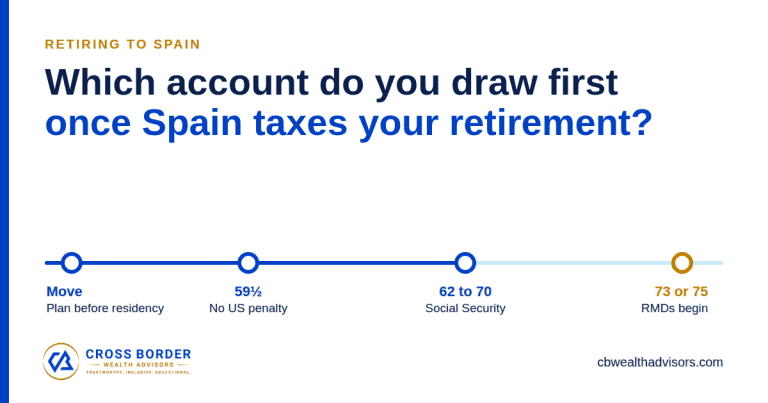
If you are close to retirement, review everything before you go. That means traditional IRAs, Roth IRAs, 401(k) plans, SEP IRAs, employer pensions and any required minimum distributions. For how those accounts fit together once you start drawing on them, see Which Retirement Account to Draw First When You Live in Spain.
Self-employed? Your Social Security contributions are a separate question. The US-Spain Totalization Agreement covers it.
Mistake 3: Ignoring banking and currency
Managing money across two countries takes more than a new bank account.
Spanish residency brings its own paperwork. Modelo 720 reports assets you hold outside Spain. Modelo 100 is the annual income tax return. Modelo 714 applies if wealth tax reaches you.
These are filing duties. They exist whether or not you owe anything, and missing them carries real penalties. Modelo 720 sets out what actually has to be declared.
There is a US-side surprise too. Some brokerages restrict or close accounts once your address of record becomes Spanish. Ask each firm in writing before you change the address, not after. Why US Brokerages Are Closing Expat Accounts covers your options.
If a closure pushes you toward Spanish investment products, be careful. Most of them are passive foreign investment companies under US rules. That is an expensive category, and The PFIC Trap explains the damage.
Currency deserves a plan as well. If your income arrives in dollars and your costs are in euros, the exchange rate quietly changes your spending power.
Mistake 4: Leaving the estate plan behind
Estate planning rarely makes the moving checklist. It should.
Spain is a civil law country. Its forced heirship rules reserve part of an estate for certain heirs. Those rules apply regardless of what your US will says.
A California living trust is the clearest example. It was drafted for a common law system. Spain does not recognize trusts at all, so it does not translate cleanly, and it can work against the plan it was meant to protect. Your US Estate Plan and Spain sets out which pieces break and why.
Review your will, powers of attorney, healthcare directives, beneficiary designations and any trusts. Do it with professionals in both countries. This matters most if you own property in more than one place, or your heirs live in different countries.
Mistake 5: Assuming domestic advice travels
It does not, and this is the mistake underneath the other four.
Cross-border planning is not a US financial plan with a passport. It means holding US tax law, Spanish tax law, reporting rules, investments, retirement income and estate planning in view at the same time.
Advisers who work in this niche regularly spot opportunities that are invisible from either side alone. The work is coordination as much as expertise.
A checklist before you go
- Fix your expected tax residency date, and count the days.
- Settle your US state residency position, and keep the evidence.
- Review every retirement account.
- Look at unrealized gains and decide what to do before residency starts.
- Ask each US institution in writing what happens when your address changes.
- Update your estate documents in both systems.
- Understand which foreign account reports apply to you.
- Review your insurance.
- Line up cross-border professionals on both sides.
Frequently Asked Questions
Should I move first and hire an adviser later?
Most of the useful moves are only available before Spanish residency begins. Starting earlier gives you more room.
Will I still file US tax returns?
Yes, in almost every case. US citizens file every year on worldwide income, wherever they live.
Should I close my US investment accounts?
Usually not. It depends on your goals, your holdings and each firm’s own policy on foreign addresses.
Does this apply the same way to everyone?
No. Your income, your accounts, your family situation and your residency date all change the answer.
Where to start
A move to Spain is a good deal more than a visa and a plane ticket. Planning ahead simplifies the filings and removes a lot of stress.
If one or two of these mistakes look familiar, a short call is an easy way to get a second opinion. It is worth having before you fix a residency date.
Book a free 20-minute intro call
Not sure which package fits you? Take the 1 minute package finder.
Planning a move? See the 12 month financial checklist.
Related reading
- The Roth IRA in Spain
- Modelo 720: What Americans in Spain Actually Have to Declare
- The Beckham Law in 2026
- The PFIC Trap
- Why US Brokerages Are Closing Expat Accounts
- The US-Spain Totalization Agreement
- Leaving California for Spain: Breaking State Residency
- Your US Estate Plan and Spain: What Does Not Travel
About the author
Victor Gersten, EA, CFP®, MS, MPAS™, is a fee-only fiduciary. He works with Americans living in or moving to Spain, and he founded Cross Border Wealth Advisors to serve them. He holds US tax credentials alongside his planning credentials.
Disclosures
This article is general educational information published by Cross Border Wealth Advisors, a company of Gersten Financial Planning Inc., an investment adviser registered with the State of California (CRD 309890). It is not investment, tax, legal or immigration advice.
Rules and figures change. The ones here are stated as of the date above. Cross Border Wealth Advisors is fee-only and receives no commissions. Registration does not imply a certain level of skill or training.
Please read the full article disclosures, which apply to everything published here.
Not sure which situation is yours? See your situation and the package that usually fits.