By Victor Gersten, EA, CFP®, MS, MPAS™ and Andrea Siminea, Anemoss Legal Advisory
Last reviewed: October 2026
For most Americans who want to retire in Spain, or simply live there without working, the non-lucrative visa is the obvious route. And the first question almost everyone asks about it is the same one: how much money do I need to show? The answer depends on the IPREM, and the IPREM 2026 figure is the number every application is measured against.
The IPREM is a Spanish figure most Americans have never heard of. It is not a salary, not a tax rate and not a cost of living estimate. It is a reference number the Spanish government uses to set thresholds for all kinds of programs, and the non-lucrative visa is one of them.
This article explains what the IPREM is, what it means for an application in 2026, how consulates expect the money to be documented, what changes at renewal, and the planning points that tend to get missed. It does not tell you whether you qualify. That depends on your own facts, and it is a question for a qualified immigration lawyer.
Quick answer
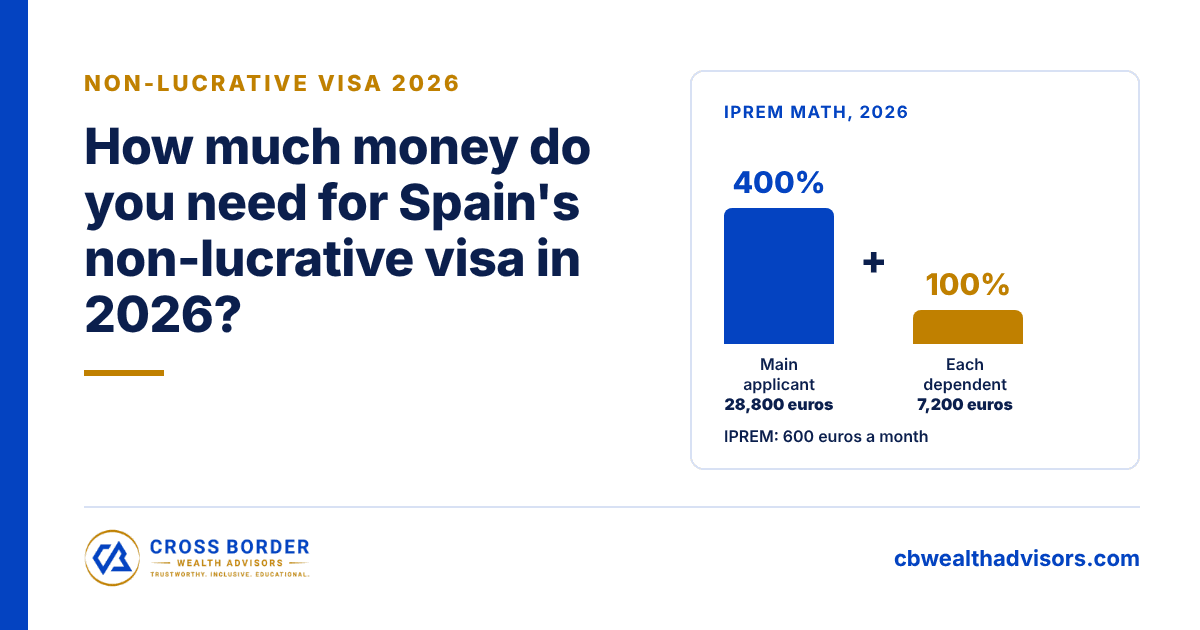
In 2026 the IPREM is 600 euros a month, or 7,200 euros a year. The main applicant shows 400% of it, which is 28,800 euros a year, and each dependent family member adds 100%, or 7,200 euros a year. At the first renewal, which generally runs for two years, a single applicant is generally expected to show 800% of the IPREM, or 57,600 euros.
What the IPREM Is
IPREM stands for Indicador Público de Renta de Efectos Múltiples, which translates loosely as the public income indicator for multiple purposes. Spain created it in 2004 to replace the minimum wage as the benchmark for public programs, so that raising the minimum wage would not automatically change every threshold tied to it.
The amount is normally set each year in the national budget law. Spain has not passed a new budget since the one for 2023, and that budget has been extended each year since. As a result, the IPREM has stayed at 600 euros a month since 2023, and the Spanish consulate in Washington confirms that 600 euros is the figure for 2026.
You will see two annual figures quoted. The 12 payment figure is 7,200 euros. The 14 payment figure, which some programs use to account for Spain’s two extra salary payments each year, is 8,400 euros. For visa and immigration calculations, Spanish authorities use the monthly figure, so 7,200 euros a year is the number that matters here.
The Non-Lucrative Visa Math for 2026
The rule is 400% of the IPREM for the main applicant, plus 100% for each family member who comes with you. Using the 2026 figure of 600 euros a month, and showing the first renewal alongside it:
| Household | Monthly | Annual (initial visa) | First renewal (2 years) |
|---|---|---|---|
| Main applicant only | 2,400 euros | 28,800 euros | 57,600 euros |
| Applicant plus one family member | 3,000 euros | 36,000 euros | 72,000 euros |
| Applicant plus two family members | 3,600 euros | 43,200 euros | 86,400 euros |
| Applicant plus three family members | 4,200 euros | 50,400 euros | 100,800 euros |
These are minimums, not recommendations. A consulate is deciding whether you can support yourself without working in Spain, and an application that clears the threshold by a thin margin can invite more questions than one that clears it comfortably. Some immigration practitioners suggest showing financial means about 15% to 25% above the minimum as a buffer. Whether that margin is right for your application is a question for your immigration lawyer.
Dollars, Euros and the Exchange Rate
The requirement is set in euros. Your savings and income are probably in dollars. As of October 2026, the Spanish consulate in Washington lists the requirement as roughly 32,000 dollars for one applicant plus roughly 8,000 dollars per dependent. Consulates may apply their own posted dollar figure, and other consulates may post different figures, so confirm the amount with the consulate that covers where you live.
The exchange rate matters in two places. First, at application time, a weaker dollar means you need more dollars to show the same euros. Second, and more often overlooked, the test applies again at renewal, and at a higher amount. A household that cleared the bar comfortably at one exchange rate can find the margin much thinner a year or two later. It helps to build that cushion into your planning rather than discovering it at renewal.
How to Prove Your Financial Means
You can qualify either by showing sufficient funds for the first year, or by showing a regular source of income that does not come from work in Spain, or a combination of the two. Each consulate sets its own document list, so always work from the one that covers your state. As an example, the consulate in Washington asks for:
- Bank statements. The last three months from all checking, savings and investment accounts.
- A bank certificate. One from each bank showing the account details, the opening date, the balance on December 31 of the prior year and the average balance for the last 12 months, with a sworn translation into Spanish.
- Proof of regular income, where relevant. Documents for Social Security benefits, a pension or an annuity, showing the current amount and that it will continue for at least the next 12 months, with a sworn translation. Retirees include an official retirement certificate.
- Your latest tax return.
The Bank Certificate Problem
The bank certificate is often the sticking point. Most U.S. banks do not issue certificates in the format Spanish consulates describe, and not every bank can report a full 12 month average. The BLS visa centers are generally familiar with this. One approach is to submit 12 months of bank statements with a short written note explaining what the bank was able to provide. Acceptance is not guaranteed and depends on the consulate.
Can Retirement and Investment Accounts Count?
Many consulates will consider retirement and investment accounts alongside bank accounts. Documents commonly submitted include:
- IRA and 401(k) statements, often with a short note explaining how and when the money can be accessed.
- Brokerage statements. Brokerage balances can generally count toward your total financial assets.
- Dividend records. Dividend income may count as regular income if it is consistent and documented for at least the previous 12 months.
Some consulates distinguish between liquid assets, such as checking, savings and brokerage accounts, and less accessible assets, such as retirement accounts with withdrawal restrictions before age 59½. Consulates may favor cash because it is easy to spend on everyday costs, but that does not mean other assets are excluded. What a given consulate accepts varies, so confirm with yours before you apply.
Why Financial Documents Get Rejected
- Inconsistent evidence. Documents with discrepancies, missing information or contradictory figures. A clear, consistent, well organized set of documents with a short summary that explains the evidence and any differences reduces that risk.
- Deposits that look artificial. Large, recent lump sums, gifts whose origin or availability is unclear, or investment or rental funds without supporting paperwork can draw extra scrutiny. Transaction records and statements that show your financial history over time help explain where the money came from.
Income From Work Does Not Count
The non-lucrative visa does not allow you to work in Spain, and that includes remote work for a U.S. employer or U.S. clients. The consulate in Washington asks applicants to sign a notarized statement committing not to work while living in Spain, and recommends that working age applicants include a termination or sabbatical letter from their employer.
If you plan to keep working remotely, the route designed for that is the international teleworking visa, often called the digital nomad visa. Its income test is tied to the Spanish minimum wage rather than to the IPREM, and the tax side of that move is covered in Working Remotely from Spain: What Americans Need to Settle Before They Go.
Renewal Is the Second Test
If you have only just arrived in Spain, renewal can feel a long way off. It comes around quickly, and what you do in your first year makes the renewal easier.
The first renewal generally grants a further two years rather than one. Spain’s official renewal guidance asks for sufficient means for the whole renewal period, and immigration lawyers read that as 800% of the IPREM for a two year permit: 57,600 euros for a single applicant, which is still 28,800 euros a year. Each dependent family member adds to that, using the same IPREM based calculation. For many people, this is the hardest part of staying on a non-lucrative visa.
| Stage | Length | Funds shown (single applicant) |
|---|---|---|
| Initial permit | 1 year | 28,800 euros |
| First renewal | 2 years | 57,600 euros |
| Second renewal | 2 years | 57,600 euros |
| After 5 years | Long-term residence | Separate application |
After five years of continuous legal residence in Spain, you may be eligible to apply for long-term residence, often called permanent residency. That is a separate application with its own requirements, not a third renewal.
When to Apply for Renewal
The renewal window opens two months before your residence authorization, shown on your foreigner identity card (the TIE), expires. An application can still be filed within the three months after it expires, but that can expose you to administrative sanctions, so filing during the two months before is the safer path.
Main Requirements at Renewal
- Time in Spain. You generally need to have lived in Spain for more than 183 days during the calendar year. That much time in Spain usually makes you a Spanish tax resident too, which is covered below.
- Financial means. Enough to support yourself, and any dependents, for the whole renewal period.
- Private health insurance that still meets the immigration requirements, including no copays and no waiting periods.
- Criminal record and public order. No disqualifying criminal record and no expulsion order or other legal bar to renewal.
- Schooling. If you live in Spain with school age children, they must be in school.
- Tax and Social Security. No outstanding debts with the tax agency or Social Security.
- Integration report, where relevant. Under the current regulation, a report on your integration may be considered in cases where one or more of the other requirements cannot be shown.
Rules and administrative practice vary with each case, so check the requirements that apply to you before you file your renewal.
The Part the Visa Does Not Mention: Spanish Tax Residency
A non-lucrative visa is an immigration status. It says nothing about tax. But living in Spain on one means spending more than 183 days a year there, and that generally makes you a Spanish tax resident, taxed on your worldwide income. Spain can also treat you as resident if your main economic interests are in Spain, or if your spouse and minor children live there. There is no split year: you are resident for the whole calendar year or not at all.
That has consequences for the very savings and income you used to qualify:
- Traditional IRA and 401(k) withdrawals are taxed in Spain as general base income at progressive rates.
- Roth IRAs. Spain does not recognize the Roth IRA’s tax free status. See The Roth IRA in Spain.
- Social Security is taxed by both countries, and how much credit Spain gives for the U.S. tax is still unsettled.
- Wealth tax and Modelo 720. U.S. bank, brokerage and retirement accounts, Roth IRAs included, count for both once you are resident. See Modelo 720: What Americans in Spain Actually Have to Declare.
- The Beckham regime is not available to non-lucrative visa holders, because it requires moving to Spain for work.
The United States still taxes you as a citizen throughout. The broader picture is in Five Financial Mistakes Americans Make Before Moving to Spain and The US Spain Tax Treaty Explained: Who Taxes What. The useful point here is timing: several decisions, such as how to handle large unrealized gains, are only available before Spanish residency begins.
Frequently Asked Questions
Is the IPREM going up in 2026?
As of October 2026 it has stayed at 600 euros a month because Spain’s 2023 budget continues to be extended. If a new budget is passed, the figure could change. Check the current amount with your consulate before you apply.
Does my spouse need to show the full amount too?
No. The main applicant shows 400% of the IPREM, and each accompanying family member adds 100%. A couple applying together would show 36,000 euros a year in 2026.
Can I count my Social Security or pension?
Regular income that does not come from work in Spain can count, provided you document the amount and that it will continue. Retirees include an official retirement certificate. Each consulate decides what it accepts, so confirm with yours.
Can I use my IRA or 401(k) for the non-lucrative visa?
Many consulates consider them alongside other accounts, but practice varies. Some treat retirement accounts as less liquid than cash, so a short note explaining how the money can be accessed helps.
How much do I need at renewal?
The first renewal generally runs for two years, so a single applicant is generally expected to show 800% of the IPREM, or 57,600 euros, plus more for each dependent.
Can I work remotely on a non-lucrative visa?
No. The visa does not permit any work, including remote work for a company outside Spain.
Ready to Talk Through Your Move?
If you are weighing the non-lucrative visa and want to see how the numbers look once Spanish and U.S. tax are in the picture, a short call is an easy way to get a second opinion before you set a move date. For the immigration side of your own application, speak with a qualified immigration lawyer.
If your move is still ahead of you, see our pre-move planning overview.
Book your free 20-minute intro call
Related reading: Five Financial Mistakes Americans Make Before Moving to Spain · Working Remotely from Spain · Moving to Spain: 12-Month Financial Checklist
About the Relationship Between the Authors
Andrea Siminea of Anemoss Legal Advisory, an independent Spanish law firm, co-authored this article. Anemoss is not affiliated with Cross Border Wealth Advisors, and neither firm pays the other for this article or for referrals. Reading this article does not create an attorney-client relationship with Anemoss or an advisory relationship with Cross Border Wealth Advisors. Cross Border Wealth Advisors does not provide legal or immigration services.
Important disclosures
This article is general educational information published by Cross Border Wealth Advisors, a company of Gersten Financial Planning Inc., an investment adviser registered with the State of California (CRD 309890). Nothing in it is investment advice, tax advice, legal advice, or immigration advice, and nothing in it is an offer or solicitation to buy or sell any security.
Tax, immigration and social security rules in the United States and in Spain change, and their application depends entirely on your own facts. Figures, thresholds, rates, fees and filing dates are stated as of the publication date shown above and may have changed since. Before acting on anything described here, consult a qualified professional about your own situation. Where this article says a point is unsettled or unconfirmed, that statement is deliberate and should be treated as a reason to seek advice rather than as a conclusion.
Cross Border Wealth Advisors is a fee-only firm and acts as a fiduciary to its advisory clients. The firm does not sell products and does not receive commissions. Registration with any state securities authority does not imply a certain level of skill or training.
No portion of this article should be read as a promise, guarantee or prediction of any particular tax, investment, immigration or planning outcome. Any calculation shown is a hypothetical illustration using round numbers for the purpose of demonstrating a mechanic. It is not a representation of any client’s experience, is not a projection of results, and does not reflect the performance of any actual account.
Web links to third-party sources are provided for the reader’s convenience. Cross Border Wealth Advisors does not control, adopt or endorse the content of linked sites.
Additional information about the firm, including its Form ADV Part 2A brochure and Part 2B brochure supplement, is available at adviserinfo.sec.gov and on request at info@cbwealthadvisors.com.
About the Authors
Victor Gersten, EA, CFP®, MS, MPAS™, is a fee-only fiduciary specializing in financial planning for Americans living in or moving to Spain. Victor founded Cross Border Wealth Advisors to serve Americans relocating to Spain, combining an Enrolled Agent’s tax expertise with comprehensive financial planning.
Andrea Siminea, Anemoss Legal Advisory
Andrea Siminea is a Junior Legal Professional with three years of international professional experience, supporting clients with legal and administrative matters in a cross-border context. With a strong foundation in Spanish law and a practical understanding of international procedures, she provides detail-oriented, client-focused support to help individuals navigate complex processes with clarity and confidence. Her international background allows her to work effectively with clients from diverse cultural backgrounds.
Works Cited
- Embassy of Spain in Washington, D.C., Consular Section, Non-working (Non-lucrative) Residency Visa, 2026 requirements (exteriores.gob.es)
- Ministerio de Inclusión, Seguridad Social y Migraciones, Hoja informativa 6, Autorización inicial de residencia temporal no lucrativa, updated May 2025 (inclusion.gob.es)
- Ministerio de Inclusión, Seguridad Social y Migraciones, Hoja informativa 7, Renovación de la autorización de residencia temporal no lucrativa, updated May 2025 (inclusion.gob.es)
- Ley 31/2022, de Presupuestos Generales del Estado para el año 2023, IPREM amounts, extended into 2026 (BOE)
- Real Decreto-ley 3/2004, creating the IPREM (BOE)
- Real Decreto 1155/2024, Reglamento de la Ley Orgánica 4/2000 (immigration regulation), in force May 20, 2025 (BOE)
- Ley 35/2006 del IRPF, Article 9, tax residency (Agencia Tributaria)
- Anemoss Legal Advisory, written input provided to the authors, October 2026