
Victor Gersten, EA, CFP®, MS, MPAS™
Most people asking whether they are on track for early retirement are really asking two questions at once. Do I have enough? And can I rely on the number I have been given?
This article covers how to think about the first question honestly. It also covers the extra questions that apply if part of the plan involves living outside the United States. This is general information rather than advice about your own plan.
The Four Inputs That Decide It
Almost every early retirement calculation reduces to four variables. People tend to spend their attention on the least important of them.
Your spending
Not your income, and not what you think you spend. Use twelve months of actual outflows. Include the annual and irregular items that a monthly budget hides. This is the most influential number in the calculation, and the one most often estimated rather than measured.
Your savings rate
This is the gap between income and spending, expressed as a percentage. It moves the retirement date far more than investment returns do, because it works on both ends of the equation at once.
The withdrawal rate you plan to take
The familiar rules of thumb came from a thirty year retirement. A retirement beginning in your forties or fifties may need to last fifty years. That is a materially different problem. A rate that is safe for one is not necessarily safe for the other.
Sequence of returns
This is the one people underweight. A poor decade of returns right after you stop earning does more damage than the same decade later, because you are selling into it. Two portfolios with identical average returns can end very differently, depending on the order those returns arrive in.
The Questions That Are Harder Than the Arithmetic
The arithmetic is the easy half. These are the parts that decide whether the plan survives contact with reality.
First, health insurance. The years between your last day of work and Medicare eligibility are often the largest single line item in an early retirement budget. That line is also the one most likely to be underestimated at the planning stage.
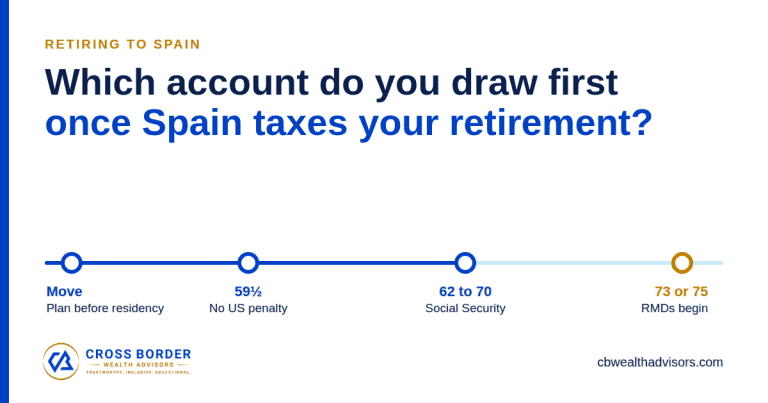
Second, access to your own money. Retiring at fifty with everything inside retirement accounts creates a problem. Withdrawals before age 59 and a half generally trigger tax and a penalty. There are routes around it, but you have to build them in advance.
Third, the behavioral question, which is not soft. A plan that is technically sound but that you cannot hold through a bad market is not a sound plan. The most expensive mistake in this field is not a poor allocation. It is selling after a decline and never returning.
What Changes If You Retire Abroad
Retiring outside the United States is one of the real levers on an early retirement plan, because it can cut spending meaningfully. It also adds a layer that domestic calculators do not model.
- A second tax system. As a Spanish tax resident you are taxed by Spain on worldwide income. Investment income falls into the savings base, at rates currently running from 19% to 30%. The US continues to tax you as well, and the foreign tax credit relieves the overlap.
- Retirement accounts behave differently. A Roth IRA is the clearest case. The US treats a qualified distribution as not income at all, and Spain is not bound by that characterization. So the account you were counting on for tax-free withdrawals may not stay tax-free. See The Roth IRA in Spain: What Americans Get Wrong Before They Move.
- Wealth tax. Spain levies an annual tax on net assets above a state exempt minimum of 700,000 euros per taxpayer, with regional variation. For a portfolio large enough to support early retirement, that can be a recurring drag no US projection includes.
- Currency. Income in dollars and spending in euros is an unhedged position. A plan that works at one exchange rate may not work at another.
- Healthcare. Care is often cheaper abroad, which is part of the appeal. However, Medicare generally does not pay for care received outside the United States.
The practical consequence is simple. A plan built entirely on US assumptions can look comfortable and still be wrong, because the largest variables change once residency does.
How to Check Where You Stand
Start by measuring twelve months of actual spending rather than estimating it. Then separate what is genuinely fixed from what is discretionary.
Next, work out what your assets would need to be to support that spending. Use a withdrawal rate suited to your own time horizon rather than to a thirty year one.
Then check the two structural questions. Can you reach money before 59 and a half without a penalty? And what is your health insurance plan for the years before Medicare?
Finally, if living abroad is part of the plan, run the same numbers with the destination country’s tax treatment applied. That is usually where the picture changes, in both directions.
Frequently Asked Questions
How much do I need to retire early?
It depends far more on your spending than on any general multiple. Start with twelve months of measured outflows. Then apply a withdrawal rate suited to a retirement that may last considerably longer than thirty years.
Can I access my retirement accounts before 59 and a half?
There are routes. They include substantially equal periodic payments and the rule of 55 for employer plans, each with its own conditions. Plan them in advance, because the structure of your accounts when you stop working determines what is available.
Does retiring abroad make early retirement easier?
It can, mainly through lower living and healthcare costs. It also brings a second tax system, possible wealth tax, and currency risk. So the net effect depends on your own numbers rather than on a general rule.
Working With a Cross-Border Advisor
Cross Border Wealth Advisors is a fee-only fiduciary firm. We serve US citizens living in or moving to Spain. I hold both the CFP® certification and an Enrolled Agent license. That combination matters here, because the withdrawal strategy and the tax return are the same problem seen from two sides.
Everything above is general information, not advice about your plan. If you want a second look at whether your numbers hold up, you can schedule an introductory conversation at cbwealthadvisors.com or email info@cbwealthadvisors.com.
Related reading: Five Financial Mistakes Americans Make Before Moving to Spain · Financial Independence and Mini Retirements
Disclosures
This article is general educational information published by Cross Border Wealth Advisors, a company of Gersten Financial Planning Inc., an investment adviser registered with the State of California (CRD 309890). It is not investment, tax, legal or immigration advice.
Rules and figures change. The ones here are stated as of the date above. Cross Border Wealth Advisors is fee-only and receives no commissions. Registration does not imply a certain level of skill or training.
Please read the full article disclosures, which apply to everything published here.