
By Victor Gersten, EA, CFP®, MS, MPAS™ and Andrea Siminea, Anemoss Legal Advisory
Last reviewed: October 2026
The non-lucrative visa is not complicated. It is just unforgiving. Most applications that run into trouble do so over a document that was a few weeks too old, a translation that was missing, or an insurance policy with a copay buried in the fine print. A good non-lucrative visa checklist is mostly about order and timing.
This checklist walks through what Americans typically need, in the order it makes sense to gather it, using the published requirements of the Spanish consulate in Washington, D.C. as a reference point. Spain has several consulates in the United States, each covering its own group of states, and each publishes its own list. Use this as a map, then work from the exact list of the consulate that covers where you live.
It then covers your first months in Spain and the first renewal, and ends with the financial checklist that sits alongside the visa, because the two are easier to handle together than one after the other.
Quick answer
Expect to gather an application form, passport, proof of residence in the consulate’s district, Spanish residence forms and fees, a notarized statement, proof of financial means, private health insurance with no copays and no waiting periods, a recent medical certificate and an apostilled FBI background check with a sworn translation. Timing matters: the background check must be issued within six months and the medical certificate within 90 days of your application.
The steps at a glance
- Before you gather anything
- The core documents
- Proof of financial means
- Health insurance
- Medical certificate and background check
- Supporting documents
- Fees and timing
- After the visa is approved
- Your first renewal
Step 1: Before You Gather Anything
- Confirm the visa fits. The non-lucrative visa does not allow any work in Spain, including remote work for a U.S. employer or clients. If you plan to keep working, the international teleworking visa is the route designed for that.
- Find your consulate. You apply to the consulate whose jurisdiction covers the state where you legally live. The Washington consulate, for example, covers Washington, D.C., Maryland, Virginia, West Virginia and North Carolina.
- Check how applications are submitted. In Washington, applications are filed in person, by appointment only, at the BLS Spain Visa Application Center. Only complete applications are accepted.
- Check your passport. Washington requires at least one year of remaining validity, two blank visa pages, and a passport issued within the last 10 years.
Step 2: The Core Documents
Based on the Washington consulate’s 2026 list:
- National visa application form, completed and signed, with one or two recent passport style photos on a white background.
- Passport, original plus a copy of the biometric pages.
- Proof of residence in the consular district, such as a driver’s license or state ID. Non-U.S. citizens also show proof of legal U.S. residence.
- Form EX 01, the Spanish application for a non-lucrative temporary residence permit.
- Form 790-052, the residence permit fee form.
- A notarized statement explaining your background, why you are moving to Spain and for how long, your commitment not to work in Spain in person or remotely, and your address in Spain for at least the first three months. It must be in Spanish or come with a Spanish translation.
Step 3: Proof of Financial Means
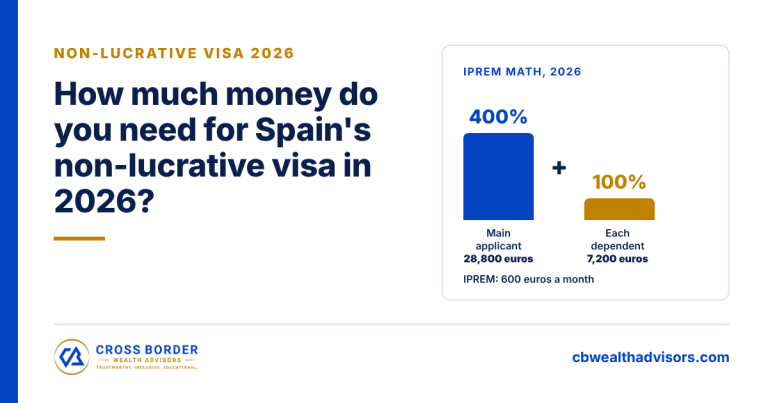
The requirement is 400% of Spain’s IPREM for the main applicant plus 100% for each family member. For 2026:
- Main applicant: 400% of the IPREM is 2,400 euros a month, or 28,800 euros a year.
- Each additional family member: 100% of the IPREM is 600 euros a month, or 7,200 euros a year.
The full explanation, including how the requirement doubles at renewal, is in our companion article, IPREM 2026: Understanding the Financial Requirements for the Non-Lucrative Visa.
Washington asks for:
- Bank statements for the last three months from all accounts.
- A bank certificate from each bank showing account details, the opening date, the December 31 balance for the prior year and the average balance for the last 12 months, with a sworn translation. In practice, not every bank can report a full 12 months.
- Proof of any regular income, such as Social Security or a pension, showing it will continue for at least 12 months, with a sworn translation. Retirees include an official retirement certificate.
- Your latest tax return.
- For working age applicants, a recommended letter from your employer confirming termination or a sabbatical.
The bank certificate is where many Americans get stuck, because most U.S. banks do not issue financial certificates in the format Spanish consulates describe. BLS offices are generally familiar with this. One approach is to submit 12 months of bank statements with a short written note explaining what the bank was able to provide. Acceptance is not guaranteed and depends on the consulate.
Step 4: Health Insurance
This is a common sticking point. Your private policy must meet the coverage standards for your type of residence permit, plus any extra requirements set by the consulate or immigration office handling your application. In practice, coverage equivalent to Spain’s public health system is generally expected. In Anemoss’s experience, consular examiners typically check four things:
- An authorized Spanish insurer. The insurer must be licensed and registered with Spain’s Directorate General of Insurance and Pension Funds (DGSFP). Several large Spanish insurers have medical networks across Spain.
- No copays at all. The certificate you give the consulate must state clearly that you pay no copayments, out of pocket fees or coinsurance for any appointment, specialist visit, emergency or hospital stay.
- No waiting periods. Full access to hospitalization, intensive care and scheduled surgery from day one. A policy with waiting periods of several months is likely to be rejected.
- Medical repatriation and repatriation of remains. Coverage for emergency international medical transfer and for returning remains to your home country in the event of death or critical injury. Not every consulate lists it, but many may require it, and it is likely to be requested when an application is filed from within Spain. Because it may be requested, a cautious planning assumption is that the policy will need to include it.
The policy must also show start and end dates, be valid for one year and be kept for the whole stay, and be in Spanish or come with a Spanish translation. Travel insurance is not accepted, and neither is an insurance card on its own.
Step 5: Medical Certificate and Background Check
These two have the tightest timing, so they are usually the last things to collect.
Medical Certificate
Issued within 90 days of your application, signed by a physician (not a nurse practitioner or physician assistant), stating that you do not have a disease that could seriously affect public health under the 2005 International Health Regulations. Washington provides a bilingual template.
FBI Background Check
Required for every applicant 18 or older. In Washington it must come from the FBI, not a state or local police department, be issued within the previous six months, cover the last five years, carry a Hague apostille on the FBI signature, and come with a sworn Spanish translation. If you spent more than 180 days in another country during the last five years, you need a background check from that country too.
The FBI check plus the apostille can take weeks. Planning backwards from your appointment date keeps the check inside its six month window when you file.
| Item | Timing window (Washington) |
|---|---|
| Medical certificate | Issued within 90 days of the application |
| FBI background check | Issued within 6 months, covering the last 5 years |
| Decision period | Up to 3 months, can be extended |
| TIE application | Generally within 1 month of arriving in Spain |
Step 6: Supporting Documents That Help
- Housing. A lease of at least three months, or a property deed if you own a home in Spain.
- Schooling. For families with school age children, a letter of enrollment from a private school in Spain.
- Family documents. For accompanying family members, birth or marriage certificates (apostilled and translated), plus proof of dependence or partnership where relevant.
Step 7: Fees and Timing
As of October 2026, the Washington consulate lists a non-lucrative visa fee of 140 dollars for U.S. citizens and a residence permit fee of 13 dollars. Fees are revised quarterly, so check the current amount before you apply. The legal period for a decision is three months, and it can be extended if the consulate asks for more documents or an interview.
Step 8: After the Visa Is Approved
The Washington consulate issues the visa for one year, and you must enter Spain within that period. Other consulates may issue it for a shorter period, so check the dates on your visa. Then the real paperwork starts. Here is what usually needs to get done in the first few months.
Certificado de Empadronamiento
Register your address with the town hall (the padrón). Most of the steps below depend on it.
Digital Certificate
This lets you deal with the Spanish administration online. It is often arranged around the same time as the empadronamiento, since it requires identity verification that many town halls can carry out.
Foreigner Identity Card (TIE)
Once you are on the padrón, apply for your TIE. The TIE application is generally required within one month of arrival, and appointment shortages at foreigners’ offices and police stations can make that hard to meet. At the appointment, the police check your visa, residence authorization and passport stamps and take your fingerprints. You receive a receipt, the resguardo, as proof you applied.
The card is usually ready in about four to five weeks, and you collect it at the same police station with your resguardo and passport. Many other procedures require the TIE.
Spanish Driver’s License
Spain has no license exchange agreement with the United States, so a U.S. license cannot be swapped for a Spanish one. A U.S. license is generally valid for six months after you become resident. After that you need a Spanish license, which means passing the theory and practical tests. More on the process in Driving in Spain With a US License.
Importing and Registering a Vehicle
If you are bringing a vehicle to Spain, the import and registration process can start once you are on the padrón. The first step is customs. A privately used vehicle moved as part of a transfer of residence from outside the EU, including from the United States, can be imported with relief from import duties and VAT. According to Spain’s tax agency, the main conditions are:
- You lived outside the EU for at least 12 consecutive months before the move.
- You owned and used the vehicle for at least six months before the move.
- You bought it with the normal taxes paid in the country you are leaving.
- You import it within 12 months of setting up your residence in Spain.
For 12 months after import, you cannot sell, lend or rent the vehicle without telling customs first. The relief is claimed on the import declaration, so check eligibility before you ship. Registering the vehicle in Spain is a separate step with its own costs.
Step 9: Your First Renewal
- When. The renewal window opens two months before your residence authorization (shown on your TIE) expires. An application can still be filed up to three months after it expires, but a late filing can trigger a sanctioning procedure.
- How long. The first renewal is granted for two years, and the second renewal for a further two years. After five years of continuous legal residence, you may be eligible to apply for long-term residence (permanent residency), which is a separate application.
- Funds. Spain’s official guidance asks for sufficient means for the whole renewal period, and immigration lawyers read that as 800% of the IPREM for a two year permit: 57,600 euros for a single applicant, plus more for each dependent.
- Time in Spain. You generally need to have lived in Spain for more than 183 days during the calendar year.
- Other requirements. Private health insurance that meets the requirements for your permit, no criminal record or expulsion order, minor children in school if they live with you in Spain, and no debts with Social Security or the tax agency.
- Integration report. Under the reformed immigration regulation, your integration may also be assessed through an integration report, in cases where you cannot show one or more of the other requirements.
- Switching to a work permit. Instead of renewing, it may be possible to move to an employee or self-employed permit. Each route has its own conditions, so check eligibility with an immigration lawyer first.
The Financial Checklist That Runs Alongside the Visa
The visa gets you into Spain. It does not deal with what happens to your money once you are there. Living in Spain on a non-lucrative visa usually makes you a Spanish tax resident, and several of the most useful decisions have to be made before that happens. Before filing, it is worth working through:
- Your expected Spanish tax residency date. Spain has no split year, so your arrival date can decide whether an entire calendar year is taxed as a Spanish resident year.
- Unrealized gains that may be worth reviewing before Spanish residency begins.
- Every retirement account. Spain does not recognize the Roth IRA’s tax free status and taxes traditional IRA and 401(k) withdrawals as general base income. See The Roth IRA in Spain.
- Modelo 720 and the wealth tax. U.S. bank, brokerage and retirement accounts, Roth IRAs included, count for both once you are resident. See Modelo 720: What Americans in Spain Actually Have to Declare.
- Social Security. It is taxed by both countries, and the Spanish credit for U.S. tax is unsettled.
- Your U.S. brokerage. Whether it will keep your account once your address is in Spain. See Why US Brokerages Are Closing Expat Accounts.
- Your U.S. state residency, especially if you are leaving a state like California. See Leaving California for Spain.
- An exchange rate cushion for renewal, when the funds requirement doubles.
- Your estate documents, which may not work the way you expect under Spanish law. See Your US Estate Plan and Spain.
Each of these is covered in more depth in Five Financial Mistakes Americans Make Before Moving to Spain and on our Moving to Spain Checklist.
Frequently Asked Questions
Can I apply for the non-lucrative visa from Spain?
Most Americans apply at the Spanish consulate that covers their U.S. residence, before they move. The 2025 immigration regulation allows some applications to be filed from inside Spain in limited circumstances. Whether that applies to you is a question for an immigration lawyer.
Do all documents need to be translated?
Many do, and it depends on the consulate. In Washington, bank statements and the tax return do not need translation, while the bank certificate, background check, insurance and several other documents do. Check each item on your consulate’s list.
My bank cannot issue the certificate the consulate asks for. What now?
This is common with U.S. banks. One approach is to submit 12 months of statements with a short written explanation of what the bank could provide. Acceptance depends on the consulate.
How long does the non-lucrative visa process take?
Allow time to gather documents, especially the FBI check and apostille, plus a legal decision period of up to three months after the consulate forwards your file.
Do I need a lawyer?
Not legally, but the requirements are strict and vary by consulate. A qualified immigration lawyer can review your file before you submit it.
Ready to Talk Through Your Move?
If you are putting together your application and want a second opinion on the financial and tax side before you commit to a move date, a short call is an easy place to start. For the immigration side of your own application, speak with a qualified immigration lawyer.
If your move is still ahead of you, see our pre-move planning overview.
Book your free 20-minute intro call
Related reading: IPREM 2026 and the Non-Lucrative Visa · Moving to Spain: 12-Month Financial Checklist · Leaving California for Spain
About the Relationship Between the Authors
Andrea Siminea of Anemoss Legal Advisory, an independent Spanish law firm, co-authored this article. Anemoss is not affiliated with Cross Border Wealth Advisors, and neither firm pays the other for this article or for referrals. Reading this article does not create an attorney-client relationship with Anemoss or an advisory relationship with Cross Border Wealth Advisors. Cross Border Wealth Advisors does not provide legal or immigration services.
Important disclosures
This article is general educational information published by Cross Border Wealth Advisors, a company of Gersten Financial Planning Inc., an investment adviser registered with the State of California (CRD 309890). Nothing in it is investment advice, tax advice, legal advice, or immigration advice, and nothing in it is an offer or solicitation to buy or sell any security.
Tax, immigration and social security rules in the United States and in Spain change, and their application depends entirely on your own facts. Figures, thresholds, rates, fees and filing dates are stated as of the publication date shown above and may have changed since. Before acting on anything described here, consult a qualified professional about your own situation. Where this article says a point is unsettled or unconfirmed, that statement is deliberate and should be treated as a reason to seek advice rather than as a conclusion.
Cross Border Wealth Advisors is a fee-only firm and acts as a fiduciary to its advisory clients. The firm does not sell products and does not receive commissions. Registration with any state securities authority does not imply a certain level of skill or training.
No portion of this article should be read as a promise, guarantee or prediction of any particular tax, investment, immigration or planning outcome. Any calculation shown is a hypothetical illustration using round numbers for the purpose of demonstrating a mechanic. It is not a representation of any client’s experience, is not a projection of results, and does not reflect the performance of any actual account.
Web links to third-party sources are provided for the reader’s convenience. Cross Border Wealth Advisors does not control, adopt or endorse the content of linked sites.
Additional information about the firm, including its Form ADV Part 2A brochure and Part 2B brochure supplement, is available at adviserinfo.sec.gov and on request at info@cbwealthadvisors.com.
About the Authors
Victor Gersten, EA, CFP®, MS, MPAS™, is a fee-only fiduciary specializing in financial planning for Americans living in or moving to Spain. Victor founded Cross Border Wealth Advisors to serve Americans relocating to Spain, combining an Enrolled Agent’s tax expertise with comprehensive financial planning.
Andrea Siminea, Anemoss Legal Advisory
Andrea Siminea is a Junior Legal Professional with three years of international professional experience, supporting clients with legal and administrative matters in a cross-border context. With a strong foundation in Spanish law and a practical understanding of international procedures, she provides detail-oriented, client-focused support to help individuals navigate complex processes with clarity and confidence. Her international background allows her to work effectively with clients from diverse cultural backgrounds.
Works Cited
- Embassy of Spain in Washington, D.C., Consular Section, Non-working (Non-lucrative) Residency Visa, required documents, procedure and fees from January 1, 2026 (exteriores.gob.es)
- Ministerio de Inclusión, Seguridad Social y Migraciones, Hoja informativa 7, Renovación de la autorización de residencia temporal no lucrativa, updated May 2025 (inclusion.gob.es)
- Ley Orgánica 4/2000, sobre derechos y libertades de los extranjeros en España (BOE)
- Real Decreto 1155/2024, Reglamento de la Ley Orgánica 4/2000 (immigration regulation), in force May 20, 2025 (BOE)
- Ley 31/2022, de Presupuestos Generales del Estado para el año 2023, IPREM amounts, extended into 2026 (BOE)
- Ley 35/2006 del IRPF, Article 9, tax residency (Agencia Tributaria)
- Agencia Tributaria, Transfer of residence: franchises and tax exemptions, vehicles on transfer of residence (sede.agenciatributaria.gob.es)
- Dirección General de Tráfico, países con convenio de canje de permisos (dgt.es)
- Anemoss Legal Advisory, written input provided to the authors, October 2026